

How Clemson football legend Perry Tuttle turned one catch into a higher calling
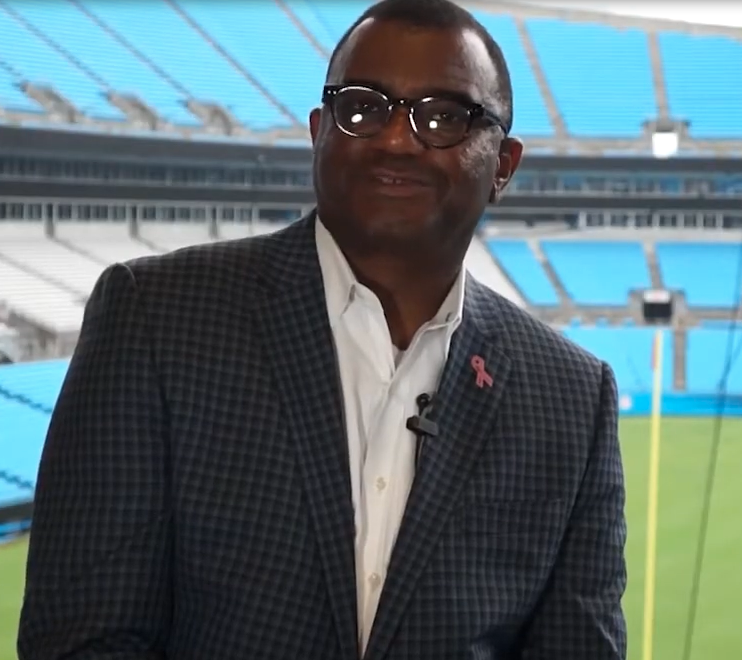
Perry Tuttle during an interview with Game Plan for Life at Bank of America Stadium in Charlotte, N.C.
Photo courtesy of Game Plan for Life
As Clemson University quarterback Homer Jordan's pass sailed through the air in the 1982 Orange Bowl, the hope of a fanbase rested on wide receiver Perry Tuttle.
“I wasn't nervous. My college roommate says that I'm the only guy in the world who can make a living off one catch,” said Tuttle.
Tuttle's catch put the Tigers ahead 22-15 over Nebraska and secured their first national championship. Years later, as a struggling pro, he would make another big play—this time in life.
“When I gave my life to Christ, I thought everything would change for the better,” said Tuttle. “There was a joy I can't explain even today, though. I've learned that following Jesus didn’t make my life better; instead, it made me better at life.”
Transitioning from football star to Charlotte Hornets chaplain, Tuttle believes God's plan for him has been clear since childhood.
Early beginnings
Tuttle, from Midway, N.C., was the youngest of seven. His father battled alcoholism while his mother held the family together.
“My mom was the closest thing to heaven I can think of,” he said. “Every day, my mom would put a scripture verse in my shoe. My mom would pray for me that God would use me.”
Tuttle was in special education and failed third grade. In fourth grade, he found football.
“I started playing Little League football with a coach named Pete Chitty,” said Tuttle. “He was taking me home from practice, and he said to me, ‘Perry, one day you're going to play in the NFL.’ I don't know if anyone has ever told you something like that, but it changed my life.”
Tuttle wore No. 22 for Cowboys receiver Bob Hayes and carried his passion to North Davidson High, leading to a visit in his senior year to watch Clemson play Notre Dame.
“I went from not talking and being very shy to dreaming about playing football,” Tuttle said. “I thought that everything that would make me happy was going to Clemson, and I did. That game was an incredible experience, and I made my decision that day.”
Clemson chronicles
Tuttle enrolled at Clemson in 1978, and the Tigers posted an 11-1 record in his first season.
Tuttle and Clemson Head Coach Danny Ford bonded over the next few seasons. Ford prepared Tuttle for the next step in his career and beyond.
“Coach Ford is one of my favorite people,” he said. “He was not only my coach but a friend. He became my dad at times and rescued me. When I look back, the best thing that ever happened to me was being around him.”
Tuttle became team captain in his senior season and led the Tigers to a national championship with seven touchdowns and 827 yards on 47 catches, capping the 12-0 run with his Orange Bowl catch.
“I'd been practicing that one catch all my life,” said Tuttle. “It seemed like it was supposed to happen that way. I'm so grateful to the Lord that, even when I wasn't walking with Him, He still had a plan for me.”
Tuttle made the Sports Illustrated cover after the catch and was drafted in the first round by the Buffalo Bills in 1982.
The next level
Tuttle faced adversity in the NFL, playing for three teams in three seasons. Despite struggles, Tuttle, who had stopped going to church in college, found his faith again.
“Everything the TV said that would make me happy, I bought, but I remember feeling empty,” said Tuttle. “I gave my life to Christ, and then I called my mom. I told her I had prayed for the very first time, and she started crying over the phone.”
The Winnipeg Blue Bombers of the Canadian Football League gave Tuttle another chance. In six seasons, he rediscovered his love for the game, recording 5,817 receiving yards and 41 touchdowns.
Choosing chaplaincy
Tuttle retired after his six-year stint in Winnipeg and began his next chapter. He finished his degree at Clemson before starting the sports marketing company Total Sports.
A phone call from former Charlotte Hornets guard Dell Curry changed his career trajectory once again.
“Dell reached out to me when the Hornets were the Bobcats and a pastor was scheduled to lead a chapel service. Well, he didn't show up. I drove down to the arena and told them my story,” said Tuttle.
Another no-show opened the door for Tuttle to become one of the full-time chaplains for the team.
“It was easy for me only because I could identify what the players were going through,” he said. “I can walk a player through not only their faith but also the challenges of fame, money, exposure and all those things these guys deal with regularly.”
Tuttle’s advice for the athletes he mentors is simple.
“NBA players are sometimes trying to stand on something that can't hold them. Basketball will let them down at some point. I tell them you’ve got to be standing on something solid, like a rock, which is Jesus,” said Tuttle.
In a world where everyone looks up to athletes, Tuttle said, using their platform to bring people to Christ is crucial.
“Our society is chasing professional athletes to the point that it's almost dangerous. So if that's the case, and I believe that's the case, we're going need pro athletes that chase after God,” said Tuttle.
Tuttle’s life shows that the greatest victories are not won on the field, but in answering a higher calling.
For the Glory of God: Sports Ministry Bearing Fruit at Rock Springs
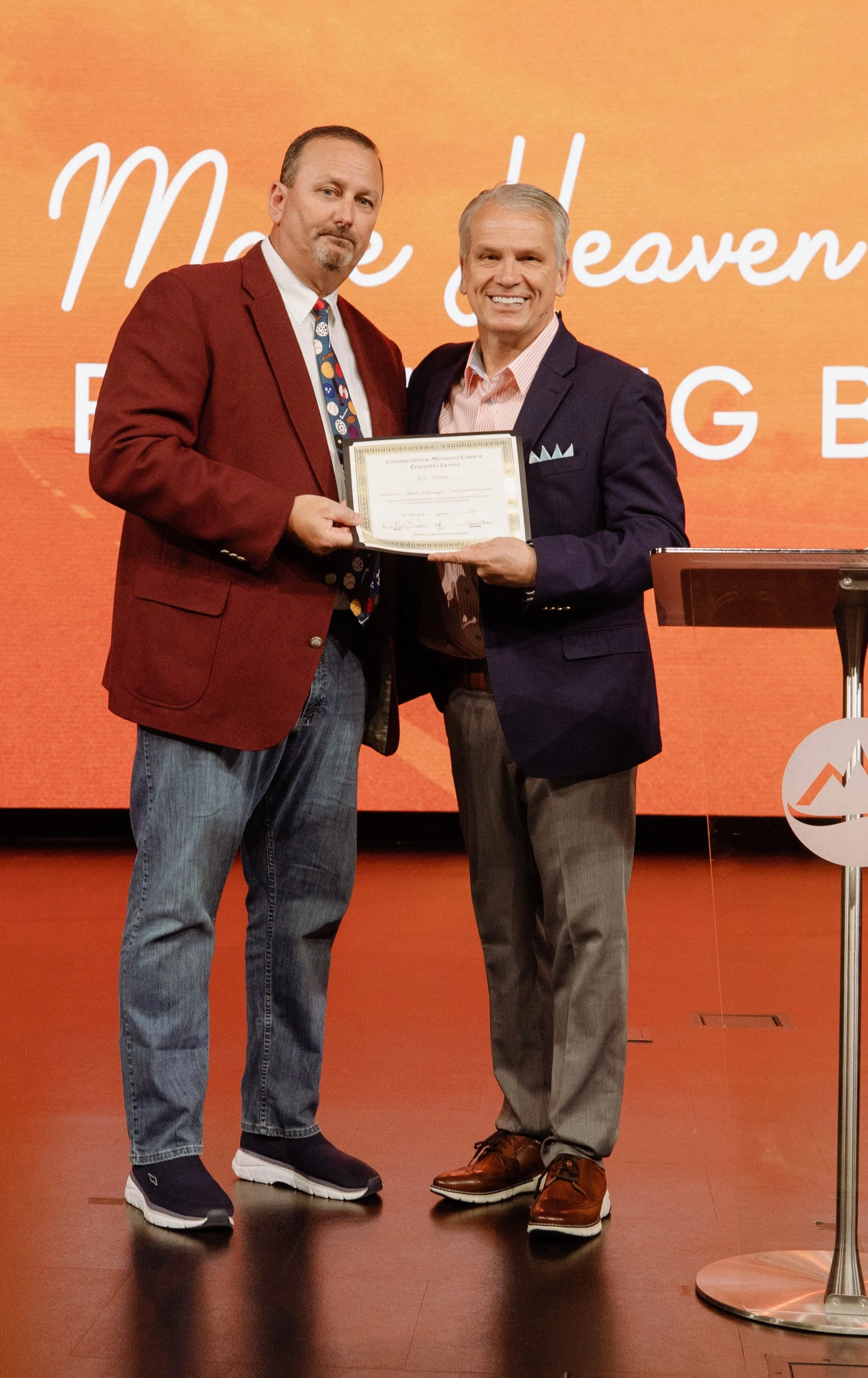
Rock Springs Church Sports Ministry Pastor Eric Habelt (left) and Senior Pastor Dr. Benny Tate (right).
Photo Courtesy of Eric Habelt
Sports are being used globally to share the Gospel. Eric Habelt and Rock Springs Church have seen significant growth, leading over 240 children to Christ in 2025.
“Our most important thing is to keep the focus where it is and stay locked in on our vision and mission to build champions for Christ,” said Habelt.
Habelt credits the partnership with CEDE SPORTS as a significant reason for the ministry’s success.
“We are so grateful for what God's doing,” said Habelt. “We're trying to grow relationships with Christ through scripture. We wouldn't be doing what we're doing without CEDE SPORTS and people like Ken Cross, who has mentored me.”
Back to the start
Habelt grew up in church and gave his life to Christ in seventh grade. He started his career in the business world before God changed his life plan.
“God gave me a nudge to go into teaching and coaching, which was my first calling,” said Habelt. “I didn't know what God would do with me after that. I was coming up on 30 years in business, and I was like, well, am I going to keep going, or does God have something in store? And after 30 years of coaching and teaching, the Lord called me into full-time ministry.”
Habelt got involved with Rock Springs Church after meeting Pastor Benny Tate. Habelt knew right away he wanted to help Tate bring his plan to fruition.
“I met Pastor Tate through circumstances that were just unique, and through that meeting, I became involved,” said Habelt. “They had athletic fields and were just getting started, doing some things, but not yet officially deciding exactly how they were going to go. They decided to go with a full-time sports ministry pastor. Thanks to that vision and the Lord's blessing on the ministry, it's been unbelievable for two and a half years.”
Rock Springs ministry
The Rock Springs Sports Ministry is about building champions for Christ through athletics. There are leagues in all sports with the express purpose of using sport as a vehicle to honor God.
Habelt said he would not have been equipped to lead without the mentorship of CEDE SPORTS Church Coach and Chaplain Ken Cross.
“Ken showed me what the difference would be,” said Habelt. “Taking it to a full-fledged sports ministry where you're not only playing the sports with a faith-based mentality but truly building champions for Christ. Everything you do must be centered around that first and foremost. The sports part is truly secondary to leading people to Christ.”
The Rock Springs Jr. Sports Leagues have flag football, basketball, soccer and baseball for youth to compete in. Kids learn weekly Bible verses and these leagues allow the church to spread the Gospel to the local community.
The church has increased its participants every year, reaching 540 in 2025. There have been 240 salvations for Christ in their ministry this year, an increase of 152 since 2024. Habelt said this feat is something they are proud of.
“We were just blown away this year by the number of kids we've been able to reach for Christ,” said Habelt. “We are just so thankful that the Holy Spirit was going crazy through the ministry. We've got so many coaches constantly working with their kids, challenging them to learn their memory verses and grow in their relationship with Jesus.”
Next steps
Rock Springs Church is looking to expand its ministry to include adult sports leagues with Frisbee and co-ed softball. Rock Springs will also host travel ball tournaments and merge with other churches to expand its ministry reach.
Habelt said that without God bringing volunteers to help them, none of this would be possible.
“I tell you, without volunteers, you can't do it. I'm just so thankful for the provision God has given us through all our volunteers and the many people involved,” said Habelt.
Habelt said they are excited to see what God will do next within their sports ministry.
We're doing a lot of long-term planning for that, as well as short-term planning for our programs here on the main campus,” said Habelt. “We want to continue growing the ministry in a way that's not about the numbers. Our most important thing is to keep the focus. If we can do that, we will be able to keep that family-first, faith-based atmosphere out there on the fields.”
To find out more about the Rock Springs Church Sports Ministry, CLICK HERE.
From the Locker Room to the Capitol: Dr. Lee Corder’s Life of Sports Chaplaincy
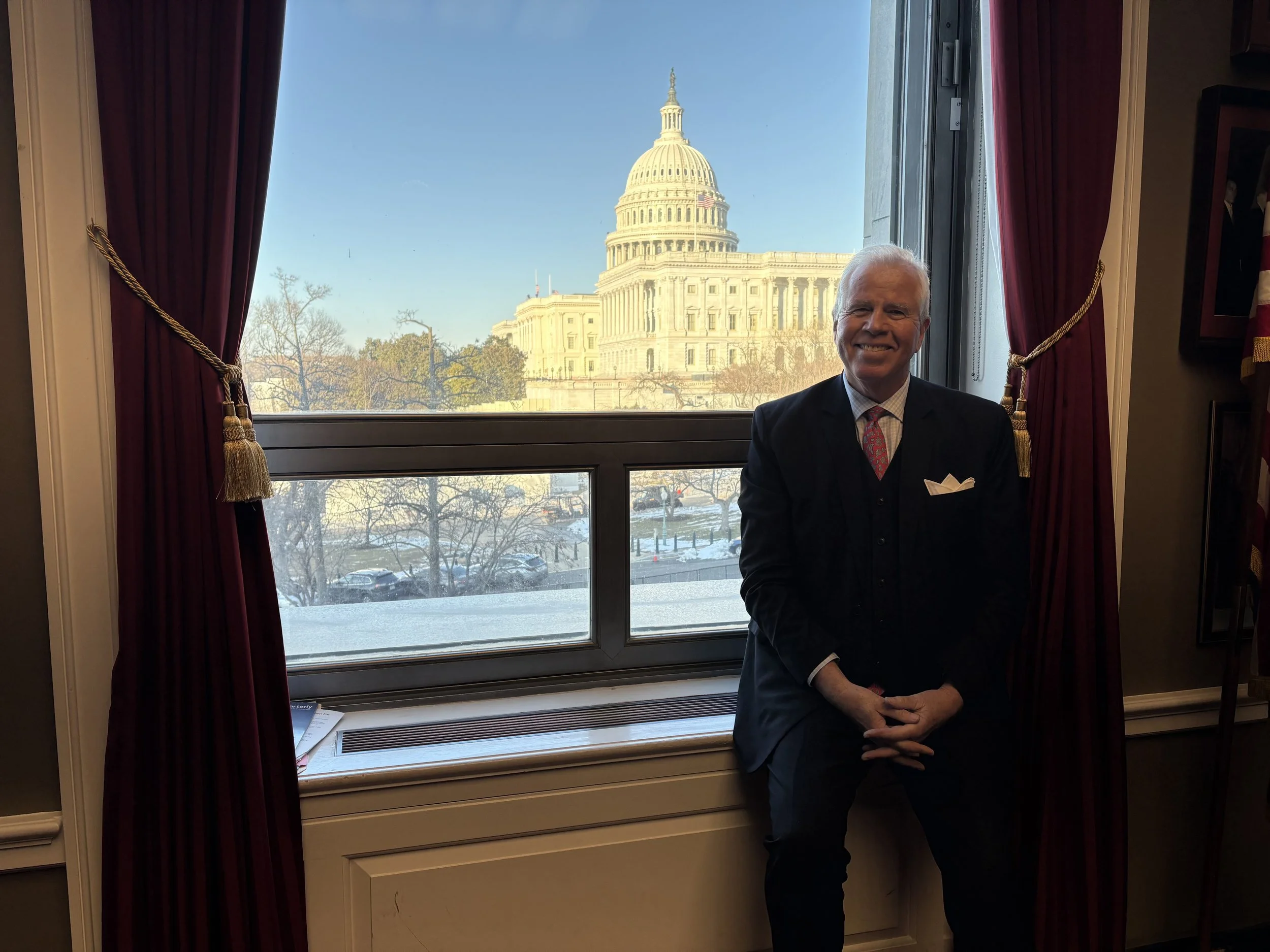
Lee Corder, former Chaplain for the Washington Redskins, in front of the Capitol Building
Photo courtesy of Lee Corder
Dr. Lee Corder served as a chaplain for the Washington Redskins for over 20 years. Corder has served in multiple capacities over the years and has consistently had God lead him in his ministry.
“I've discovered more often than not, when I've done something and think, ‘boy, that was really good, that really impacted people.’ I hear nothing,” said Corder. “ More often than not, somebody will come up to me a month later, a year later, ten years later, and say, ‘You know, Lee, I remember the time you and I were doing this. or you came to visit me, or you said this.’ I don't remember those things. What that says to me is that you never know how the Holy Spirit's going to use something.”
CEDE SPORTS sat down with Corder to discuss his ministry, his relationship with former Redskins Head Coach Joe Gibbs and tips for chaplains.
CS: Can you describe yourself?
Corder: I'm the son of a Baptist minister and a Navy nurse. I grew up in Roanoke, Virginia, and then moved up to Northern Virginia when I was in junior high.
CS: How did you come to know Christ?
Corder: I grew up in the church, indeed always believed in Jesus, but I went through a crisis in my senior year at university with some depression, and that's where Jesus became real to me in a different way. I appropriated my own faith. I was baptized in the church and went forward, but I think it was in my fourth year at university that He became real to me and I began to grow in my relationship with Him personally.
CS: How long have you worked in chaplaincy?
Corder: I actually worked with the federal government for a couple of years. I was a political science major, then worked in D.C., but got involved as a volunteer leader with Young Life. I went on staff with Young Life, and that's what led me to become a sports chaplain because we got to know Joe Gibbs through his sons, J.D. and Coy, who were involved in Young Life. When Joe needed another chaplain at Redskins Park, he asked me if I would fill in, and I did during training camp. He said, "Will you keep going?" And so I kept going for almost 20 years.
CS: How would you describe your time as the sports chaplain in Washington?
Corder: In D.C., back in the day, even being the Redskins chaplain was a pretty big deal. I had to discipline myself constantly to be aware: this is about Jesus, not me. I'm here to serve. That was really crucial. I'm grateful that I had friends challenging me on that regularly. Having a little group of friends, both family and peers, was invaluable and kept me on track.
CS: How would you describe your relationship with Joe Gibbs?
Corder: Joe is a friend. I worked for him, but over the years, he became a friend and a man I have great respect for. His heart is to honor Jesus and to care for people. We were in the Super Bowl in 1992 in Minneapolis. We were playing the Buffalo Bills. The night before the game, I was walking down the hallway to set up for chapel. He decided he wanted chapel open for families, so we had about 500 people coming. The team was coming out of walk-through. It's the last thing they do, practice-wise, before a game. They were in ballroom 1, and we were going up to ballroom 2, and as I'm walking up the hallway, here comes Coach Gibbs out of the practice. He says, ‘Hey Lee, come here a second.’ He's very intense when he's focused on something. He said, ‘You make sure that tonight at chapel, for people to have a chance to pray and give their lives to Jesus. Make sure of that, will you?’ I remember my first thought being, ‘Well, oh, my gosh, you've got a Super Bowl tomorrow, buddy. You've got to focus.’ Then I remember thinking, ‘Wow, isn't that powerful?’ What's he thinking about on the night before a Super Bowl? He's thinking about people having an opportunity to say yes to Jesus. That, to me, is Coach Gibbs.
CS: For someone wanting to get started in sports chaplaincy, what advice would you give them?
Corder: First, the only person you can truly win to Jesus is yourself. I learned that from my father-in-law. We're responsible for our journey with Jesus. I have to make sure that every day when I start my day, I'm winning myself again to Jesus, that I'm trying to meet with Him, hear Him, let Him speak to me, comfort me and convict me. If I don't do that, I've got nothing to offer. If you're gonna be a really good chaplain, you better be winning yourself to Jesus every day, because that's the one person you're responsible for. Number two: be prepared. Failing to prepare is preparing to fail. The fact is, I had people in my life who challenged me to do essential things. My old supervisor in Young Life made us do the topical memory system. It's called the TMS, a 60-verse piece we had to learn word-perfect. That's just one way of saying preparation. I can't tell you how many times, on the sideline, I used a verse from memory when a player needed encouragement or asked for a Word. I had already been equipped. I had them in my quiver. When I needed them, they were there. That was huge. The third thing I'll say is, sports chaplaincy is not a program; it's a relationship. You can't fake showing up. You've got to show up, not just for chapel. You have to go to practice, too. You've got to be on turf with folks. Whether it was Young Life or Redskins Park, I had to learn the discipline of walking down the stairs to the locker room and the training room. Most people are intimidated to go down those stairs. It's a little intimidating, but if you're not doing that, you're not being a sports chaplain. A sports chaplain shows up and is present in their people's lives. You've got to show up and build relationships, and out of that comes the opportunity to care for people.
CS: How has God shown up in your life and ministry?
Corder: I could tell you that most of the things I've probably done that are most valuable in life, I wasn't even aware I was doing, which tells me it was the spirit of God. All I could do was be available, and then he used me and surprised me. It's the feeding of the 5,000. I bring my little loaf and fish, and I give it to Jesus, and he feeds people I didn't expect. You've got to be walking with Christ and then know that the Holy Spirit's going to do things through you. You don't even anticipate or recognize it after it happens. That was the fun of this journey.
CS: What are you doing now, and what is next for you?
Corder: I was with Young Life the whole time and retired in 2020. I was overseeing all their international work. I've also been involved with the National Prayer Breakfast. I'm doing what I did at Redskins Park, going there two or three days a week, spending time. What I did at Redskins Park, I'm doing in the U.S. House of Representatives with the prayer breakfast group there. I'm just walking in, meeting folks, building friendships and trying to talk about Jesus. I do that a couple of days a week, but it's all voluntary. I'm very grateful we can do that. There is a full-time chaplain with the House, and I serve alongside and support them.
Keeping Christ at the Center: The Lifelong Ministry of Bob Dyar
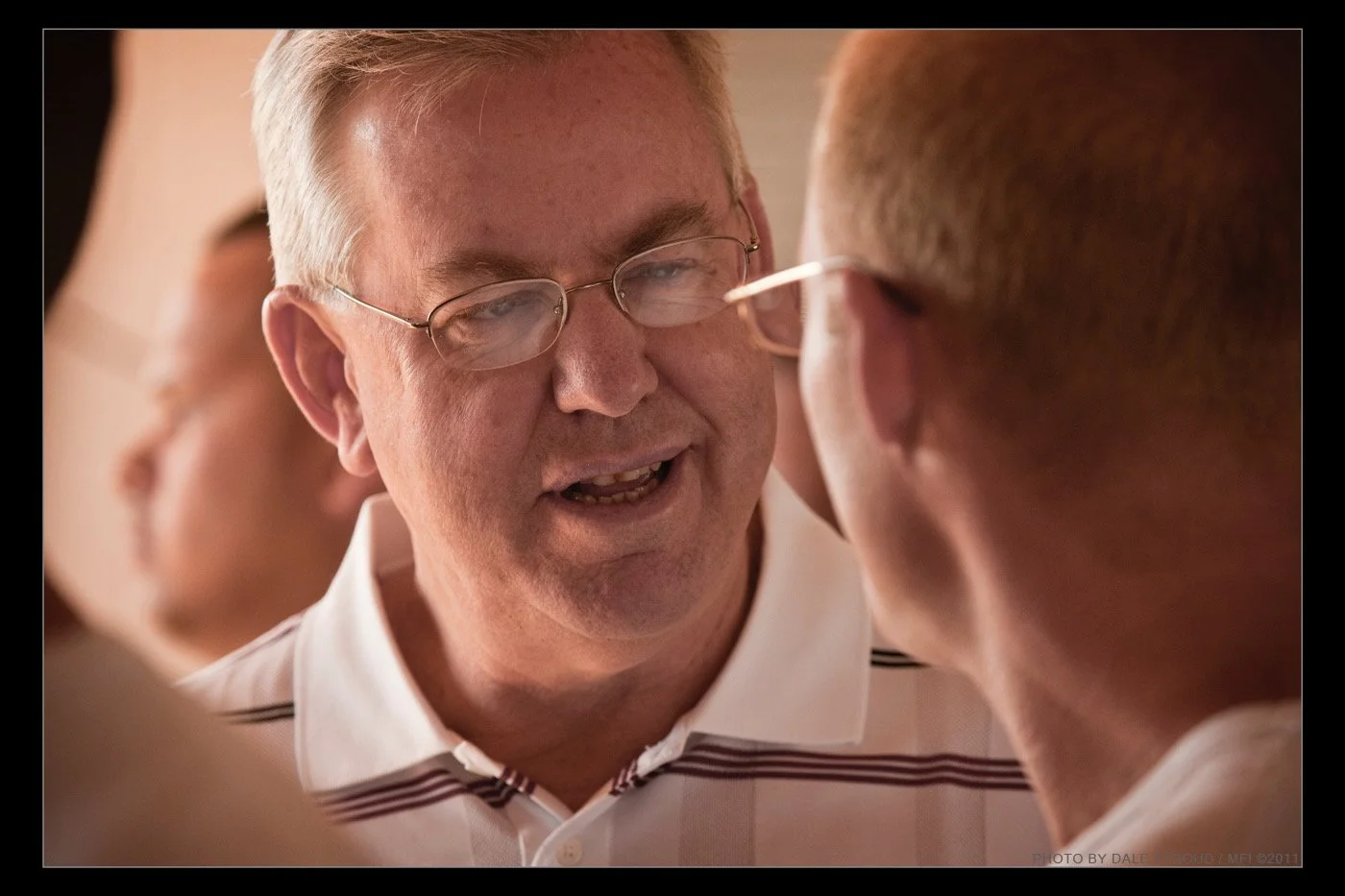
CEDE SPORTS Founder Bob Dyar speaking with others while doing ministry work.
Photo courtesy of Bob Dyar
Founder and CEO of CEDE Sports and Joe Gibbs Racing (JGR) Chaplain Bob Dyar, has been involved in sports ministry for over 35 years. Dyar created CEDE in 1996, and God has continued to grow the organization.
"We're trying to be faithful to what God has called us to do, and as a result, we're seeing a multiplying ministry happen. After 30 years, we are still doing the same thing," said Dyar.
That same mission has been reflected in the organization's values. Dyar said keeping Christ in the middle is the most critical aspect of the ministry.
"I am for trying to do things in such a way that it constantly keeps us Christ-centered," said Dyar. "I want to focus on Christ, not on the gospel. I want to worship Christ."
The early years
Dyar is originally from Columbia, S.C., and grew up with a love for all sports. He came to Christ during his senior year at Spring Valley High School, marking the beginning of his spiritual journey.
"I went to a meeting one night," said Dyar. "I heard about who Jesus was and what he had done. I'd never really understood Christianity. That was my first real understanding of biblical Christianity. That was when I committed my life to Christ."
Heading into college, Dyar attended Wofford College in Spartanburg, S.C., playing for the golf team. Dyar was there for two years, winning a national title with the squad before transferring to the University of South Carolina in the summer of 1974 to obtain a Bachelor of Science in Computer Science.
Dyar became involved with multiple campus ministry organizations during his time at South Carolina.
"The dilemma I faced was that when I became a Christian, the God of my life up to that point had been sports and competition," said Dyar. "I got heavily involved with a local church even while I was in college. That was a significant growth for me in terms of understanding scripture, what it means to follow Jesus and how I live that out."
Dyar took the next step in his education by attending The Ohio State University to obtain a Master of Science in Computer Science in 1976, but he did not feel it was a good fit. After a year in Columbus, Dyar returned to South Carolina in 1977 to pursue his Master of Business Administration.
A career switch
After obtaining his MBA, he started working in the Information Systems Industry, but God had a different plan for his life.
"I got involved in the local church, but in 1987, after my dad died, I began to realize that I had always been doing what I did to please him. I realized I no longer had to do that, and I could do what I felt like God was calling me to do," said Dyar.
After working at Christ Covenant Church for five years, he was asked to attend a race by the founder of Motor Racing Outreach (MRO), Max Helton, who was a member at the church. That race changed Dyar's career trajectory once again.
"I didn't know anything about racing. Racing is boring. I didn't really want to go," said Dyar. "I saw Max's ministry with a lot of NASCAR guys. He probably connected with more non-Christians, loving them, caring for them, telling them about the gospel, than anybody I've ever seen."
Shortly after the race, Helton and the MRO board voted for Dyar to become their executive director in 1993. After three years with MRO, Dyar jumped over to JGR after leading Bible studies with the team.
"I turned 40 in 1994, and it was then that I began to realize I had a real passion for sharing the gospel and discipling new believers. That was the job description for chaplains in race teams. I was the first chaplain for a race team," said Dyar.
Over the years, Dyar has grown the ministry at JGR, and he said his favorite part is helping others on their spiritual journeys.
"I love seeing guys come to Christ and then begin to grow spiritually," said Dyar. "It's neat to see how God has used our work at Joe Gibbs Racing to impact not only people here but also those on other race teams."
CEDE Sports
In 1996, Dyar created CEDE Sports, meeting the need of mobilizing churches and chaplains into sports ministry built upon relational outreach.
Dyar said putting God's plan first is the mindset of the organization.
"God has been faithful to continue to grow CEDE Sports," said Dyar. "In times when we weren't trying to grow, he brought growth. Other times when we thought we were going to grow, he slowed things down. That's okay with us. We don't have this plan that we're hoping God blesses. We're just trying to follow God's plan."
In 25 years, CEDE has worked with thousands of local churches on five continents and sports chaplains in more than 100 countries. Currently, CEDE has staff and associates in North America, South America, Europe, Asia and Africa.
"I had a world map on the wall, and I didn't know why. Now I understand why, because God is using what we're doing around the world," said Dyar.
When it comes to legacy, Dyar wants to be remembered for one thing.
"I hope people see Christ in me," said Dyar.
Dyar's life and ministry reflect a steadfast commitment to keeping Christ at the center of everything he does. Through CEDE Sports and his chaplaincy at JGR, he continues to impact lives around the world by faithfully following God's call.
From Racing to Ministry: Jon Wehner’s Journey of Faith

Joe Gibbs Racing Chaplain Jon Wehner has been a part of the CEDE Sports team for 14 years
Photo by CEDE SPORTS
Joe Gibbs Racing Chaplain Jon Wehner has been a part of the CEDE Sports team for 14 years. From a career in racing to ministry, Wehner has always felt God's presence in his life.
"When I turn the water on in the morning, the water comes out of the faucet. I feel like God has intervened," said Wehner. "He's always behind me, and it's just natural, but it's always these dramatic things that God does. It's just got to be him."
Growing up
Wehner grew up in Eastpointe, Mich. His parents, originally hailing from northern Indiana, made the move when his father got an auditing job with Chrysler.
Wehner grew up in a Catholic household and gave his life to Christ in eighth grade.
"We found a good community at St. Veronica's," said Wehner. "I was confirmed in eighth grade. However, when I graduated, I just felt something was missing. I knew there was more."
The North Carolina move
In 1992, Wehner moved to North Carolina to pursue a career in racing. After a conversation with God, he made the move and started working for Ray and Diane Dewitt.
"I was helping them as a weekend warrior, and they said, 'Does anybody want to come down here full-time with us?' At the time I was married, I had a house and prayed about it. I said, 'Lord, what do you think?' And the house sold overnight," said Wehner.
His role changed from part-time to full-time when he was brought on to help Mark Vieau build engines. Wehner had never worked on engines, but Vieau helped him learn the ropes.
"He [Vieau] wanted to hire someone with no experience," said Wehner. "He knew that training someone from scratch would eliminate any bad habits. He took me under his wing and hired me off the street to work in the engine shop on the chassis and car side."
A move into ministry
During his time in racing, Wehner experienced back-to-back NASCAR Craftsman Truck Series Championships. While excelling in the field, a connection with Motor Racing Outreach (MRO) NASCAR Xfinity Series Chaplain Ron Pegram changed Wehner's trajectory again.
"Max Helton, who was running MRO, wanted to hire an Xfinity Series chaplain, and that man was Pegram," said Wehner. "Ron was my mentor, who showed me what Christianity could truly be like. It was at that point that I started teaching Bible study at our church."
Wehner then decided to attend East Coast Bible College before moving on to Gordon-Conwell Theological Seminary, where he earned his Master's Degree in Divinity. After training up an assistant to take his place on the racing side, he started leading a Monday Night Bible Service full-time at Grace Covenant Church in Cornelius, N.C.
CEDE Sports
Wehner spent five years leading the Monday Night Bible service and establishing the ministry. He felt called to something new at CEDE Sports due to a friendship with the Founder and CEO, Bob Dyar.
"Again, I'm like, what are you doing, God?" said Wehner. "There was someone who had worked here and said, 'Hey, Bob Dyar, his assistant who does the books, is getting ready to leave, and he needs somebody to work for him, so go see Bob.' Bob took a chance on me."
Wehner was hired in 2011 to handle the books and assist with ministry tasks as the director of operations. He held the role for three years before starting to work with Joe Gibbs Racing as a chaplain.
Wehner said his favorite part of chaplaincy is the personal connection.
"The most rewarding part is working with the guys on the floor and making sure they know that there's a God who loves them. Getting together with them and offering hope in a sometimes helpless situation is why we do it," said Wehner.
Perspectives on faith
For Wehner, CEDE Sports is making a difference in the lives of others. Wehner said the work of CEDE Sports allows for growth in spiritual journeys.
"To use sport as a way to talk about our Heavenly Father and letting the spirit open those doors, and it's just a catalyst," said Wehner. "We are using what God has opened a door for and taking full advantage of it in a positive spiritual way. CEDE has got everything to do with God."
Wehner believes that not relying on one's own understanding is key. Getting into the Word is a piece of advice he would give to others.
"The impact of the Word is crucial. It can speak differently and you are never going to hear the same verse the same way. When you go through tough times, Scripture pops out," said Wehner.
Being a family man, Wehner and his wife Christie have five children and a grandbaby boy. Wehner wants to leave behind a legacy where he loves his family and God receives the glory through his actions.
"I want people to think of me as a man of faith. It's all about God," said Wehner. "In Colossians, it talks about Jesus being the visible image of an invisible God. Jesus left in Acts, leaving his Holy Spirit. I believe that if we're to represent Christ, we can be a visible image of an invisible God through our actions and words."
Wehner’s journey from racing to ministry reflects a deep commitment to living out his faith in every aspect of life. Through his work, he continues to inspire others by being a visible example of God’s love and presence.
Faith and Leadership: Ken Cross’s Path
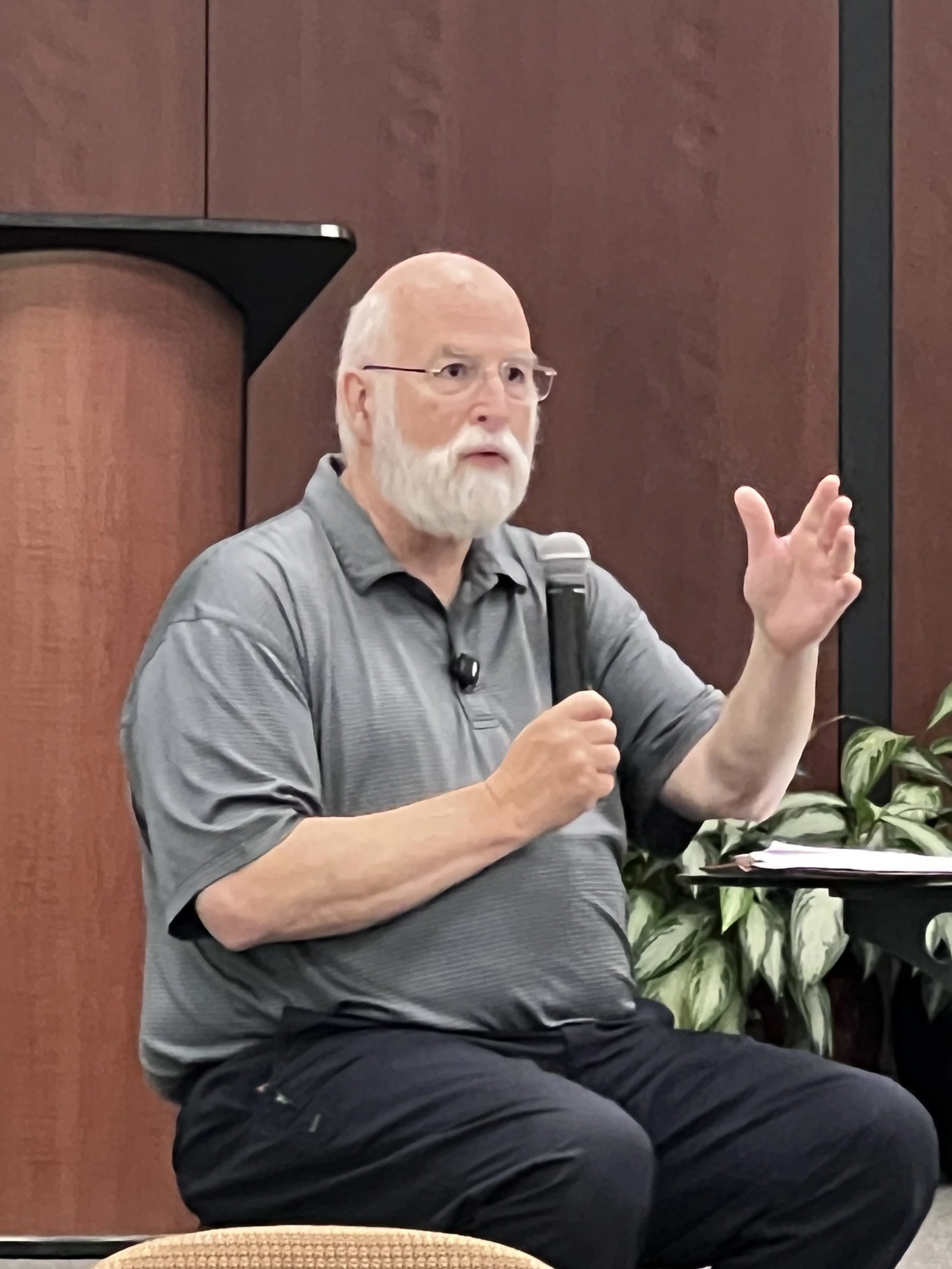
Joe Gibbs Racing Chaplain and Church Coach Ken Cross leading Wednesday Bible Study
Photo courtesy of Ken Cross
Joe Gibbs Racing (JGR) Chaplain Ken Cross wears many hats in his ministry work. For CEDE Sports, Cross serves as the coordinator of churches, which allows him to cultivate his passion for helping others grow.
"My spiritual gift is exhortation, which is a speaking gift," said Cross. "That gift enables me to come alongside people, encourage them and also provide guidance on how they can continue to develop."
Cross said the church connection is essential to the work CEDE Sports does.
"Church sports serve as a bridge to reach unbelieving families and bring their children onto the campus, while also acting as a discipleship ministry that recruits and equips people within the church," said Cross.
Navigating loss and life
Cross grew up in Birmingham, Ala., and was raised by his mother with his three siblings. Cross' father died when he was six, which was a pivotal moment in his life.
"My mom ended up going to work, and she was gone every day," said Cross. "We had to mature earlier. Thankfully, my mom did a great job. I learned to cook, I could clean the house and do laundry."
The death of his father led to feelings of resentment towards God. When Cross was 19, a visit to a youth group started his spiritual walk.
"We went on a retreat in December, and our youth pastor shared the Gospel. It was as if I had wax buildup in my ears," said Cross. "I'd never heard of the resurrection. When I heard the Gospel about a living Jesus who could change you from the inside out, that gave me hope. I realized he's a father to the fatherless."
Cross came to Christ shortly after and felt an immediate change in his life.
"The gifts God gave me changed me. I avoided classes in high school that had a public speaking aspect in them, and now I've preached all these decades," said Cross.
Cross took the next step of attending Southeastern Bible College in Birmingham to get his Bachelor of Arts in Bible and Pastoral Theory.
Six months into his junior year, he relocated to California to serve as an assistant pastor at a church. Cross finished college in California in 1981 and enrolled at the Reformed Theological Seminary just four years later to pursue his Master of Divinity.
A journey in ministry
Cross obtained his degree and held multiple positions, including senior pastor, church planter and chaplain, from 1988 to the present. He is considered a man who wears many hats.
"Having been in the ministry for a long time, I learned what I enjoy and what I'm good at, and I'm a people person," said Cross. "Working with people is energizing for me. As a pastor, I've always worked with others to help them know how to communicate with their senior pastors."
Currently, Cross holds positions with the Sports Outreach Group as its vice president and with the Sports Chaplains Network as its director of training. He also served as a volunteer chaplain for the University of North Carolina at Charlotte women's basketball team and the Queens University of Charlotte men's Basketball team from 2012 to 2020.
CEDE Sports and JGR
In 2016, Cross joined CEDE Sports as a staff member. A connection with Bob Dyar led to Cross becoming a member of the JGR chaplains team.
"When I started doing chaplaincy work, Bob encouraged me to pursue it," said Cross. "Bob said, 'Ken, I want you to be a chaplain here, reach out to these people.' That was a no-brainer, and it's just been delightful since I've been here."
Cross knew that CEDE was the right fit for him at the start.
"Fundamentally, some of the things that Bob holds dear are fundamental to who I am. He wants to build up the body of Christ," said Cross. "I've told the leaders the last couple of weeks that my definition of a growing Christian is someone who's using their spiritual gifts and enjoying it."
Cross, a seasoned veteran, has discovered how to help churches take the next step in their sports ministries.
"I have learned concepts on how to help churches. Every time you interact with somebody, you're learning new things and finding better ways to approach certain situations and meet people where they are," said Cross.
Life philosophy
Cross said that when ministering, we need to deal with everyone individually.
"I've always felt that applying Scripture is essential. When I was preaching all the time, I would think about the retiree and the 7-year-old boy. I'd think about the high school girl. I'd think about the single mother. I'd consider the various individuals present and how this passage would apply to them," said Cross.
Cross said that what keeps him going is the impact he has on others through God's presence.
"I hope that my legacy will be that I end well, and that the things God has used me for in other people's lives will be multiplied in the lives of others," said Cross.
Cross's lifelong commitment to ministry reflects a deep passion for encouraging others, equipping the church and leaving a legacy rooted in faith and service.
Hudson Belk: Faith, Sports and the Call to Ministry
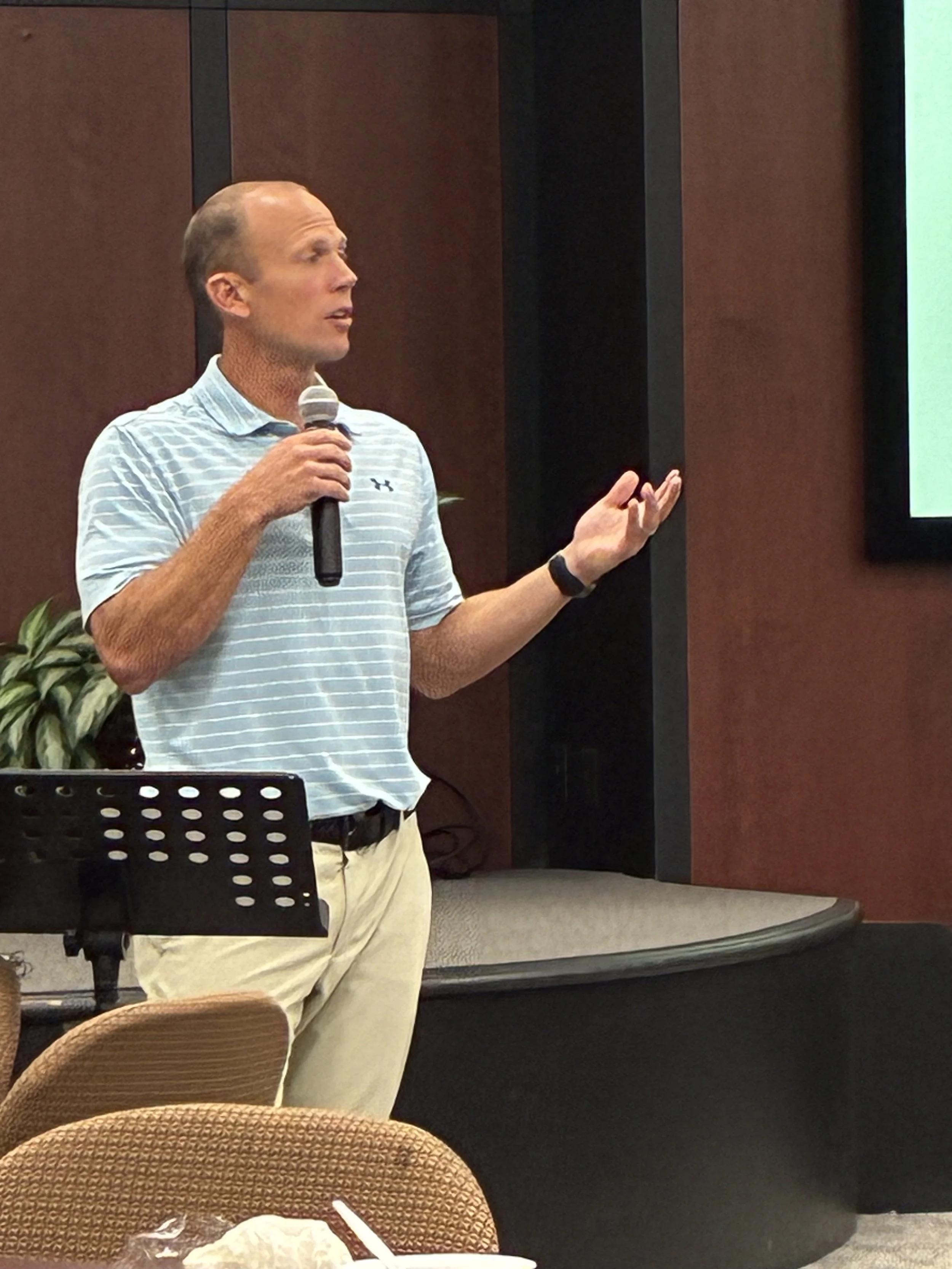
Joe Gibbs Racing Lead Chaplain, Hudson Belk, leading Wednesday Bible Study
Photo courtesy of Hudson Belk
Joe Gibbs Racing (JGR) Lead Chaplain Hudson Belk leads as the coordinator of the ministry. Belk, who has worked with CEDE Sports since June 2011, said his purpose is to be led.
"I remember to look to Jesus and let him be the motivation, even for all of my obedience and desire for faithfulness to God. In ministry, that's what I'll point people to: Jesus," said Belk.
Belk has various responsibilities, including assisting with the equipping process for churches and leading Bible services at JGR.
"We're trying to figure out how to help churches leverage the resources God has given us to use sports as a bridge and a laboratory for sharing the gospel," said Belk.
Early years
Belk spent the first five years of his life in Seneca, S.C., before moving to Charleston. Both of his parents graduated from Clemson University, passing down a legacy.
Belk grew up in a Christian household and knew early on he needed a savior.
"I grew up in the church hearing the Gospel a lot. I remember even my dad doing door-to-door evangelism," said Belk. "The reality of my sin, and the need for the hope of Heaven that's only found in Christ, was something as a kid that I was just exposed to."
Spiritual growth
Belk gave his life to Christ at the age of five, which marked the beginning of his spiritual journey. Over the years, he grew to understand the Gospel more, but he still had questions.
"I developed a deep love for the Lord, but I also put a lot of pressure on myself to be a witness for Jesus," said Belk. "I felt extreme pressure, not realizing that it was the spirit of God working in me to do that, and that it was His work in my life."
After high school, Belk, who had achieved success in baseball, took his talents to the Citadel Military College of South Carolina. Belk, expecting to play right away, had to take a redshirt year, leading to a spiritual breakthrough.
"I was struggling in school and sports," said Belk. "Making me wonder, 'What do I have?' That was a huge breakthrough moment, where I realized what it means to depend on Him as the true God of my life."
Before his junior year, Belk transferred to Clemson, where he continued working towards a degree in business management. Outside of academics, Belk was starting to get involved with a few student ministries on campus.
"God had been doing a lot in my life, and I got involved with some campus ministries and was just finding so much joy in the ministry aspect," said Belk.
Path to ministry
After graduating, God had plans for Belk's future and created an unexpected path.
"Growing up, I knew the Gospel and had a heart for ministry, but I didn't know much about it. Being a pastor didn't seem like the future for me, and it wasn't on my mind," said Belk.
Belk was approached to lead a campus ministry at The Citadel in Charleston. He spent three years there, and God once again stepped in.
"I met my now-wife, and we were planning to get married. I was also going to leave the staff," said Belk. "Our campus ministry was undergoing some transitions and was planting a new ministry in North Carolina. There was all this transition, and I thought, 'You know what? I think I've done my time with this. God, where are you leading me?"
Belk felt a strong desire to pursue ministry, and with his wife, Catherine's, support, he moved to Charlotte to attend Reform Theological Seminary. After three years, he earned his Master of Divinity and planned to work for a denomination to further engage in college ministry.
God brought Bob Dyar, Founder and CEO of CEDE Sports and the Lead Chaplain of JGR, into Belk's life. On the day of Belk's graduation, Dyar offered him a position.
"I met Bob, and interestingly, his daughter was also involved in the same campus ministry as I was, so we built a relationship," said Belk. "Bob said, 'Why don't you think about coming and working with me doing chaplaincy at Joe Gibbs Racing?' I decided to do that as I felt like it fit my gifts."
Time at JGR
Belk has spent over 14 years at JGR, utilizing his platform for discipleship through Bible studies and small groups. Belk said his favorite thing is the access to the people.
"It's the favor we're given to enter into people's lives, build relationships with them and learn their stories. I'm thankful for the access to that, which allows me to do that in a relational context," said Belk.
Belk has felt God using him to help others come to know Him.
"I am drawn to non-believers evangelistically, but I also want to see those who are following Christ grow into leaders, and to help them become deeply rooted," said Belk.
CEDE Sports connection
The JGR ministry is one of the central pillars of the CEDE Sports mission. Belk, who leads the JGR Ministry, feels CEDE has empowered him to go deeper.
"What gets me most excited about CEDE Sports is that we believe in the Bible. Then we want to take what God has given us and use those gifts to see the Gospel go forth, to see disciples made, and to see the Great Commission happen," said Belk.
Belk said the need for CEDE Sports continues to grow.
"The importance of the local church lies in making disciples and staying under the authority of God's Word," said Belk. "These kinds of things that we cling to are essential, and there's a great resource in using sports. God has given me a love for sports, allowing me to connect with people for a much greater cause through CEDE."
Faith perspectives
Belk is a loving husband and father to three girls, Bailey, Emma and Harper, which has helped him grow spiritually. Belk said what drives him is wanting people to know Jesus and his goodness.
"I hope my legacy is that people were drawn to him through whatever interactions God gifted me with them," said Belk. "I'm someone who needed Jesus, and people got to know how much they need Jesus through time with me."
Belk's journey from athlete to chaplain reflects a life shaped by a deep desire to lead others to Jesus. He continues to use his passion for sports as a powerful bridge to share the Gospel and make disciples.